The clean energy transition depends on more than breakthrough technologies. It depends on solving the stack, and the Pacific Northwest is quietly doing exactly that.
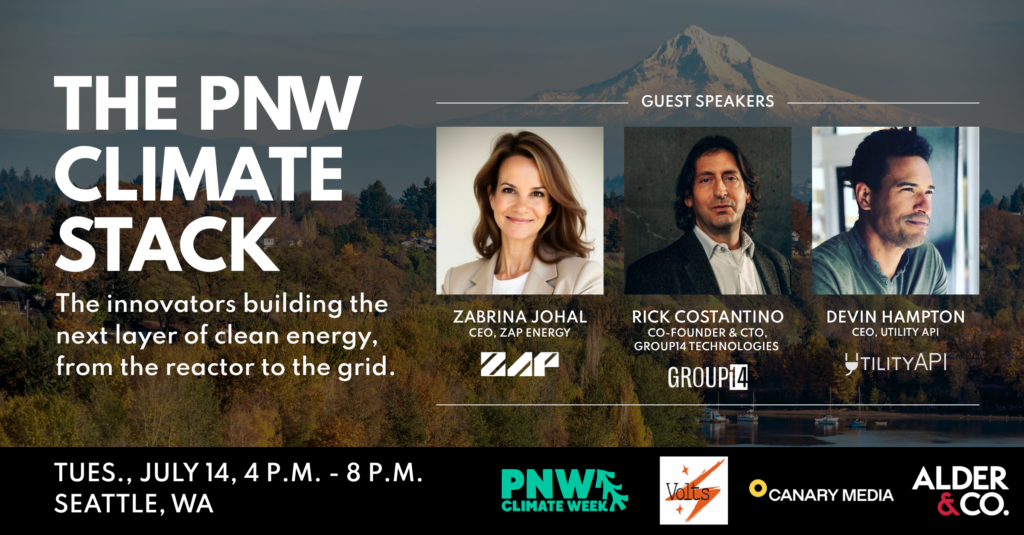
On a July evening during PNW Climate Week, Alder & Co. brought together Canary Media, the Volts podcast, and a room full of people who wanted to understand what is actually being built in the Pacific Northwest.
It was exactly what we hoped for: three conversations, three different bottlenecks in the clean energy transition, and one bigger story about where this region is headed.
A huge thank you to our partners at Canary Media and David Roberts at Volts for making this happen, and to our speakers for their generosity with their time and ideas. Thank you also to our venue and catering team for keeping everyone well fed and the conversations going long after the program ended.
Fusion, Fission, and the Long Game
Eric Wesoff opened the evening with Zabrina Johal, CEO of Zap Energy, and within minutes the room understood why the company has become one of the most closely watched names in advanced nuclear.
Zabrina started with a science lesson that actually landed: the difference between fission and fusion, what plasma is, and why nuclear matters at all. In simple terms, nuclear energy, whether splitting or fusing atoms, is millions of times more energy dense than burning fossil fuels. That density is why so many companies are betting on it to meet future electricity demand.
What makes Zap different is what it isn’t building. No superconducting magnets the size of cathedrals. No facility packed with 192 lasers firing at a pellet the size of a BB. Zap’s approach uses plasma as its own conductor, generating a magnetic field when electricity is pulsed through it from capacitor banks housed in standard Conex containers. It’s an elegant design intended to make fusion smaller, simpler, and easier to scale.
Zap is also taking a different approach to commercialization. While most fusion companies avoid fission entirely, Zap is developing both on a shared platform, with common engineering, supply chains, and heat exchange systems. The company is targeting advanced fission in the early 2030s and commercial fusion later that decade. It’s a pragmatic strategy. Utilities need reliable, carbon-free power long before commercial fusion arrives.
One of the most memorable parts of the conversation wasn’t about physics. It was about leadership. Zabrina spoke candidly about being the first woman on her Navy ship, deploying to the Persian Gulf without even female restroom facilities, and later finding herself the only woman in rooms filled with nuclear executives. Innovation isn’t only about technology. It’s also about who gets to build it.
The Bottleneck Nobody Talks About
Devin Hampton, CEO of UtilityAPI, admitted he never planned to run the company. He joined to lead business development after working on the Obama campaign, at the Department of Energy, and at the U.S. Trade and Development Agency. When the board asked him to step into the CEO role, he said yes because he believed he was the right person for that moment.
UtilityAPI is building the trusted exchange layer between utilities and the thousands of companies that need customer-authorized utility data. Solar installers, virtual power plants, battery companies, EV charging providers, carbon accounting platforms, and AI-enabled energy services all depend on that information. Until recently, accessing it often meant paper forms, manual approvals, and weeks of waiting.
Devin described UtilityAPI as the Plaid for energy. Just as secure data sharing transformed financial services, utility data is becoming the infrastructure that unlocks entirely new energy markets.
Today, UtilityAPI has 14 million meters under contract and serves more than 2,500 companies, including Sunrun, Tesla, WeaveGrid, Stem, and Generac. Devin expects that number to nearly double over the next year.
The technology, however, isn’t the hardest part. Regulation is.
Devin shared the story of New Hampshire, where lawmakers approved a statewide utility data platform only to see the effort undone after a new legislature took office before implementation. Meanwhile, every delay means another six months or year of startup runway disappears. Texas, through Smart Meter Texas, remains the only state to solve this at scale, while Australia has built similar capabilities nationally. Everyone else is still catching up.
The Battery Breakthrough Happening in Our Backyard
David closed the evening with a live recording of Volts featuring Rick Constantino, CTO of Group14 Technologies.
Rick began with a reminder that surprises almost everyone: while battery headlines have focused on lithium iron phosphate, nickel manganese cobalt, and other chemistry breakthroughs, nearly all of that innovation has happened on the cathode side. The anode has remained graphite since lithium-ion batteries were commercialized in the early 1990s.
Silicon has long been viewed as the obvious successor because it can store roughly ten times more lithium than graphite. The challenge is that it expands dramatically while charging, eventually cracking itself apart.
Group14’s solution is a porous carbon scaffold with nanoscale silicon grown inside it, giving the silicon room to expand without destroying the battery. The result is dramatically higher energy density and much faster charging while fitting into today’s lithium-ion manufacturing lines without requiring entirely new factories.
Rick’s path to batteries was just as interesting. Before energy, he worked in pharmaceutical drug delivery, designing microscopic structures that slowly released medicine inside the body. The same thinking eventually inspired Group14’s approach to silicon anodes.
Today, Group14’s materials are already shipping in consumer electronics, manufacturing is expanding in Woodinville and Moses Lake, and the company is working with the overwhelming majority of global battery manufacturers as they evaluate or commercialize silicon anodes. Rick believes silicon will become the dominant anode material over the coming decade.
Three Companies. One Regional Advantage.
What made the evening memorable wasn’t simply hearing from three impressive companies. It was realizing they are solving three different constraints in the same energy system.
Zap is working on the long-term supply of firm, carbon-free power. UtilityAPI is building the digital infrastructure that allows distributed energy resources to participate in the grid. Group14 is improving the batteries that make electrification faster, lighter, and more practical.
Taken together, they describe something much bigger than three successful startups. They describe an energy stack, one that is increasingly being designed, built, and commercialized in the Pacific Northwest.
The Pacific Northwest isn’t waiting for permission to lead. It’s already doing the work.
Breakthrough technology doesn’t become market leadership on its own. It takes the right strategy, positioning, and story to earn customers, investors, and industry trust. That’s what we do. If you’re building the future of climate technology, let’s talk about what’s next.
Written by

Melanie Adamson
Melanie has worked tirelessly for over twenty years to shape marketing strategies and storytelling for energy and climate tech. She is passionate about making climate technologies universal while ensuring climate justice for all, which drives her leadership, innovation and mentorship. Mel envisions using Alder and Tofu as a platform to extend the climate message, activate complacent norms, and influence a new generation of climate heroes. When Mel isn’t running Alder, she loves cooking for family and friends, and sharing stories with a glass of French or Spanish red wine.